
Author: Eylül Karabulut, senior ELT student and private tutor.
Teaching a language has been greatly changed with the advance of the communicative approaches. Thus, the aim of teaching a language has shifted to what is called information exchange, strategies to communicate (strategic competence), knowledge on how to use the language based on a certain context (sociolingustic and pragmatic competence) and forming the language and basic knowledge of the rules of that language (grammatical competence) and to produce coherent utterances (discourse analysis) (Celce – Murcia, 2001. P.17). Basically, the main purpose of ELT is to provide an environment or context where students can communicate meaningfully and purposefully Keeping all this in mind, it is time to decide on how to apply all this theory to our English classes.
First of all, before beginning to apply main activities, it is important to start with a “warm-up”. This will energize your students as well as activating their background knowledge (i.e., schemata). The other consequences of using a warm-up activity are that it creates expectations about the language, which means that your students will be prepared for the upcoming activities. What is more, it motivates the students to use the target language (Tanner, R., Green, C., 1998. P.31-32). Besides, when our topic is concerned, warm-up activities give your students a chance to use the language meaningfully. As for my suggestions, I strongly recommend an activity which is called “Draw a star”. Although I invented the name, the activity is widely used as a creative drama activity.
“Draw a Star”
Aims:
- to prepare students for the upcoming activities
- to foster peer interaction
- to motivate students
The teacher should begin by showing his/her star. On each corner of it, there are five things about himself / herself. It can be a number, a proper name or the name of a place. Then, the teacher wants the students to guess what each corner stands for. For example, if it writes “rose”, it may mean that it is the favourite flower of the teacher. After all of them make their guesses, it is now their turn draw a star and fill in the each corner. At the end, they share the stars with their partner (desk mate) and make guesses about themselves.

Following the warm-up activity, it is important to divide your main activities as pre, while and post. This way will help your students to activate and use their background knowledge (pre), make a connection between the new information and the previous one via various activities such as reading, listening (while) and to apply their new knowledge and make another connection with a new skill or sub-skills (post). When it comes to make your class more communicative in those stages, there are some activities that are suggested.
Firstly, in pre activities, it can be a pre-reading activity, students look at the picture or the title and make guesses about the main idea of the text. Thus, students have an expectation and an idea on the main message and aim of the text. A speaking activity can be used in this part. Here is a sample lesson plan for pre-reading :
Level: B1
Topic: Emergency and Health Problems
Pre-reading Stage:
Aims:
- To activate schemata
- to provide background information and context
- to preview vocabulary
The teacher aims at providing context as well as previewing vocabulary in this stage. By providing the context, the students have a kind of purpose to read or use the target language. Besides, studying the basic vocabulary related to the text makes it easier for them to read and comprehend the text. As a result, they feel more motivated and confident or in other words, the teacher lowers their affective filter.
Steps:
- the teacher draws a circle on the board and writes Covid-19 in the middle of it. Here the teacher aims to preview the vocabulary that is used in the text. The teacher says “I have drawn a circle on the board. I want you to tell me what comes to your mind when you see this word. I will be the first because in this way it will be easier to understand. Okay? Let’s get started. I want to start with symptoms because when I see the word Covid-19, this word usually comes to my mind. What about you? What comes to your mind related to symptoms? You can give examples if you want.” The teacher writes the word symptoms deliberately in order to present the vocabulary related to it such as cough, fever, shortness of breath, loss of smell and taste, etc. Then, the teacher writes precautions and follows the same procedure.
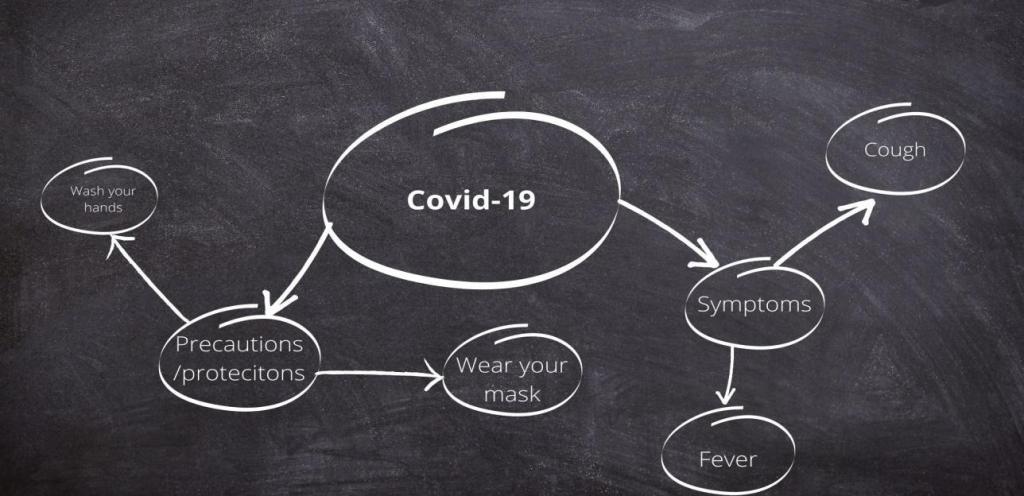
Credits: The word web was designed by using Canva.
- The teacher introduces the main topic and what they are going to do by saying “Now, we will look more closely at Covid-19. I have a text for you. I am sure you will learn lots of things about it. However, before reading it, let’s watch a video related to it. Also, please watch it carefully because there are some questions in the video.”
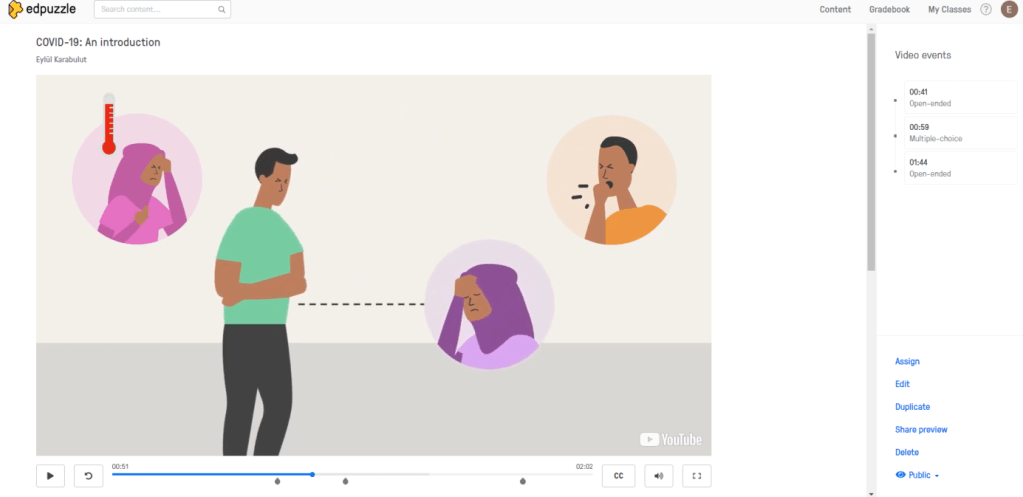
- After finishing watching the video, the teacher introduces the text and distributes them to the students. The teacher says “You were great, we have learned lots of words about the symptoms. Now, it is time to read the text. Before starting to read it, I want to know how you read a text or a book. Do you usually read all of them? Or Do you read just some parts of them to understand them?”
*The teacher asks these questions in order to know what kind of reading strategy that the students know (explicit strategy instruction). The other aim is to prepare them for the reading strategies that they are going to use during the reading task.
- Then the teacher says “Thank you for your answer. I am sure you want to know why I asked this. Because we are going to use some of them while reading the text. I will explain them in a minute.”
- Video-Ref: https://www.youtube.com/watch?v=zME-84Vwjuo,
- https://edpuzzle.com/media/60a2adbc3449ce418bbb1ade
After doing all the activities, it is time to switch to the while-reading activity. In our daily life, we read for the main idea or we read just one part which serves our needs. Therefore, in this activity, you can provide skimming ( e.g., looking for the main idea) or scanning (e.g., finding a specific information from the text such as date, number, name). Finally, when it comes to post-reading or post-activity, a new skill (listening, speaking, writing) or sub-skill (i.e. pronunciation, grammar, vocabulary) can be added. As I mentioned above, student also need to have grammatical competence. For this reason, a grammar point can be explained via guided discovery or PPP (present, practice, produce) approach. Here is an another example of a grammar teaching via guided discovery and a role-play activity:
Post-reading Stage:
Aims:
- To get students to internalize the vocabulary and structure
- To present a new structure (i.e. the dialogue between a doctor and a patient) by involving students in a communicative and interactive activity (role-play).
In this stage, the teacher connects the topic with a role-play activity. The teacher wants them to find a partner and gives each student a role card. In this role-play activity, one student becomes a patient who has been infected with Covid-19 while the other student is the doctor. This activity not only gives them a chance to internalize the vocabulary but also provides a context where they are used and how they are used. Besides, the students learn how the interaction between a doctor and a patient occurs and what kind of language is used by putting themselves in the characters’ shoes.
Steps:
- The teacher explains the activity “We have learned lots of things about Covid-19. Right? Its symptoms and protections. Before doing our next activity, I have a question for you. Think that you have the virus or you have been injected with it. Or you think that you may have it but you are not sure. Where can you get information about it? How can we know whether we are sick or not?” After the teacher gets the answer of calling the doctor or she/he may give the answer, the students are informed about the activity.
- The teacher says “One of the answers is to call or to see a doctor. We are going to do a role-play activity about it. I have two role cards. One of you becomes the doctor and your friend becomes the patient. Before giving them, let’s talk about their conversation. What do we speak with a doctor? What do we tell her/him?” Then, the teacher introduces a specific structure, which is giving advice by using should, must, have to. “When you go to a doctor, she gives you an advice. Right? And she can say you should wear your mask. Can you give me another example?”
- ● The teacher writes some statements on the board and asks the students which one belongs to the patient and which one belongs to the doctor. Then, the teacher takes their attention to do highlighted parts. What is the purpose of “should” here?” After getting the answers she/he introduces must and says “there is also must. They mean that something is necessary. For example, you must stay at home.
- After discussing the roles of a doctor and a patient. The teacher distributes the role cards. While the students are speaking, she/he walks around the class and helps them with the task-related language if necessary (e.g. vocabulary, sentence structure).
*The teacher does not give the correct answer when they need any help related to the language. Instead of direct correction, the teacher uses the technique called embedded correction, or in other words, she/he recasts. For example, if one of the students cannot pronounce a word correctly, the teacher repeats the answer with the correct use of the word.
Sample dialogue and matching activity

Ref: It was designed by using Canva
| Doctor Ask your patient how he/she feels and what the symptoms are Give advices to your patient to feel good and protect herself/himself. (You should, you had better…) |
| Patient Talk about your feeling or symptoms. Want your doctor to give an advice. (Can you give me an advice? What should I do?) |
References:
Celce-Murcia, M. (2001). Teaching English as a second or Foreign Language. Third Edition.
Tanner, R., Green, C. (1998). Tasks for Teacher Education: a Reflective Approach.
 Teaching and Learning English